How to Play Wahoo: Rules for the Marbles and Dice Game
Wahoo is a race game for 2 to 4 players: roll a die, move your marbles once around the board, and get them all into your home column before anyone else. Land on a rival's marble and it goes all the way back to the start. It belongs to the same old family as Pachisi and Ludo, and goes by plenty of names: Wahoo, marbles and dice, the marble game, or just "the board Grandpa made".
These are the rules Marble Bounce uses, with the common variations people argue about at the table. You can play it free in your browser, against the computer or online with friends, with nothing to download.
The short version
- Roll a 1, 5 or 6 to bring a marble out of your pen onto your start hole.
- Move one marble clockwise by exactly the number you rolled.
- Land on a rival's marble to send it back to their pen, and roll again.
- Rolling a 6 earns another roll.
- You can hop over rivals' marbles, but never over or onto your own.
- Go once around the board, then into your home column. First to get every marble home wins.
The board
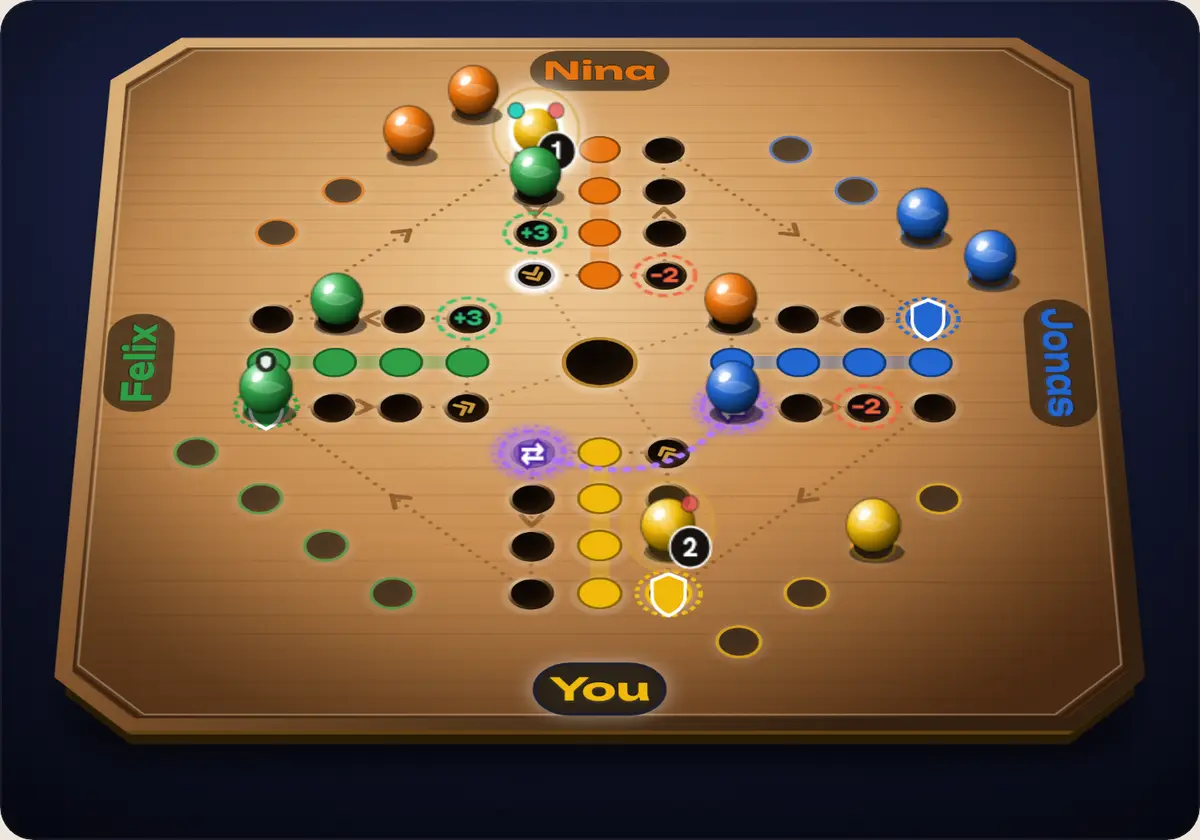
The board is a cross with four arms. Around its edge runs the track, 32 holes in all, 8 on each arm. Each player sits at one arm and owns:
- a pen in their corner, where their marbles wait at the start;
- a coloured start hole on the track, where marbles come out;
- a home column of 4 holes running in from the edge toward the middle.
In the very middle is the center hole, and each arm has one shortcut hole (marked with small dashed lines) that leads into it.
Setting up
Each player picks a colour and puts their marbles in their pen. With 2 or 3 players the empty arms are simply part of the track.
How many marbles each player races decides how long the game lasts:
- Dash: 2 marbles each, and both must get home.
- Classic: 3 marbles each. The standard game.
- Marathon: 4 marbles each. The full board.
Taking a turn
Roll the die, then use the roll on one marble:
- Come out: with a 1, 5 or 6, move a marble from your pen onto your start hole. If one of your own marbles is already sitting there, you can't.
- Move: move a marble on the track clockwise by exactly the number rolled.
If you can make a move, you must make one. If you can't, the turn passes, with one exception: while every marble is still in your pen, you get two more rolls to try for a 1, 5 or 6.
Rolling a 6 always earns you another roll after your move.
Blocking: your own marbles get in your way
You may hop over your rivals' marbles as you move. You may never hop over or land on your own. Two of your marbles close together can block each other, so it is worth spreading them out.
Bumping
Finish a move exactly on a rival's marble and you bump it: it goes all the way back to its owner's pen and has to come out again with a 1, 5 or 6. Landing a bump earns you another roll.
Start holes are safe. A marble sitting on its own start hole can't be bumped. Rivals can hop over it, but they can't land there.
The center hole
The center is a shortcut across the board, with a risk attached.
- Diving in: if one of your marbles is on a shortcut hole and you roll a 1 or 6, you can move it into the center instead of moving forward.
- Shooting out: a marble in the center leaves with a 1 or 6, onto any of the four shortcut holes, your choice. If a rival is sitting on the hole you pick, you bump it.
- Only one marble fits. If a rival dives into the center while your marble is there, yours is bumped back to your pen.
A Center Shot can jump a marble most of the way around the board, or knock out a rival who thought they were safe on the far side.
Getting home
After one full lap of the track, a marble turns off into its own home column instead of going round again. Inside the home column:
- nobody can bump it;
- a roll too big for the room left takes it as deep as it can go, to the last free hole, so a big roll is never wasted on a marble heading home (with the Exact count home house rule it must fit exactly, the classic way);
- it can't hop over your own marbles there either, so move the leading marble deepest first and leave room for the rest.
The first player to get all their marbles into their home column wins.
Team play
With 4 players you can play in two teams: opposite corners are partners. A team wins when both partners have every marble home, so helping your partner (and bumping the other team) matters as much as your own race.
House rules and variations
Every family plays Wahoo a little differently. These are the variations Marble Bounce lets you switch on in the setup screen. With all of them off you get the standard game above.
- Strict entry: only a 1 or 6 brings a marble out of the pen, not a 5. This is how many traditional boards are played. Games run longer.
- No safe start holes: a marble sitting on its own start hole can be bumped like any other.
- Bumps don't earn an extra roll.
- Sixes don't earn an extra roll.
- Soft bumps: a bumped marble goes back to its own start hole instead of the pen, so it is back in the race straight away. Kinder, and shorter, for younger players.
- Exact count home: the classic finish. A roll too big for the room left in the home column can't be used on that marble. Games run longer, mostly at the end.
- No bumps: nobody is ever sent back. You can't land on a hole a rival's marble is sitting on (you can still hop over it), so the game is a pure race. The gentlest way to play with small children.
- Chaos mode (its own button on the main menu, and a switch in an online room): a few holes on the track become special, placed fresh every game. A boost throws a marble 3 holes further on, a slide drops it back 2, and a pair of portals swaps it across the board. Whatever is sitting where it lands gets bumped.
Strategy tips
- Get marbles out early. More marbles on the track means more choices for every roll.
- Watch the six holes behind you. A rival marble 1 to 6 holes behind yours can bump it on their next roll. Moving out of range, or onto your start hole, is often worth more than racing ahead.
- Park on your start hole when you need a safe spot. Nobody can bump a marble there.
- Use the center when the coast is clear. A dive is safe until somebody else dives in, and coming out with a 1 or 6 can cover most of a lap.
- Bump the leader. Sending back the marble closest to home hurts the player most likely to win.
- Fill your home column from the back. Move your first marble all the way in, so the next ones are not blocked.
Questions people ask
How many players can play? Two to four. In Marble Bounce the computer can fill any seat, so you can also play alone.
What do you need to roll to get a marble out? A 1, 5 or 6 in the standard game. If your family only allows a 1 or a 6, switch on Strict entry.
Do you need an exact roll to get home? Not in Marble Bounce's standard game: a roll too big moves the marble to the deepest free hole of its home column. Families who play the classic way can switch on Exact count home, where a roll has to fit exactly and a too-big one is used on another marble or lost.
What happens when you land on your own marble? You can't. A move that would land on, or pass over, one of your own marbles isn't allowed.
Can a marble in the home column be bumped? No. Once it is in, it is safe.
Can I play Wahoo online with friends? Yes, free. In Marble Bounce choose Play online, create a room and share the four-letter code. Everyone plays on their own phone or computer, and a computer player can fill any empty seat.
Ready to play?
The fastest way to learn is a game. Play Marble Bounce now in your browser, or start with Learn to play, a two-minute tutorial on a live board. When you have the hang of it, try the daily Puzzles and Marble Run, a run of stages with special marbles that change the rules.
Want to play with family who live far away? Here's how to play Wahoo online with family and friends. Wondering how Wahoo compares to the boxed games? See Wahoo vs Aggravation vs Sorry.